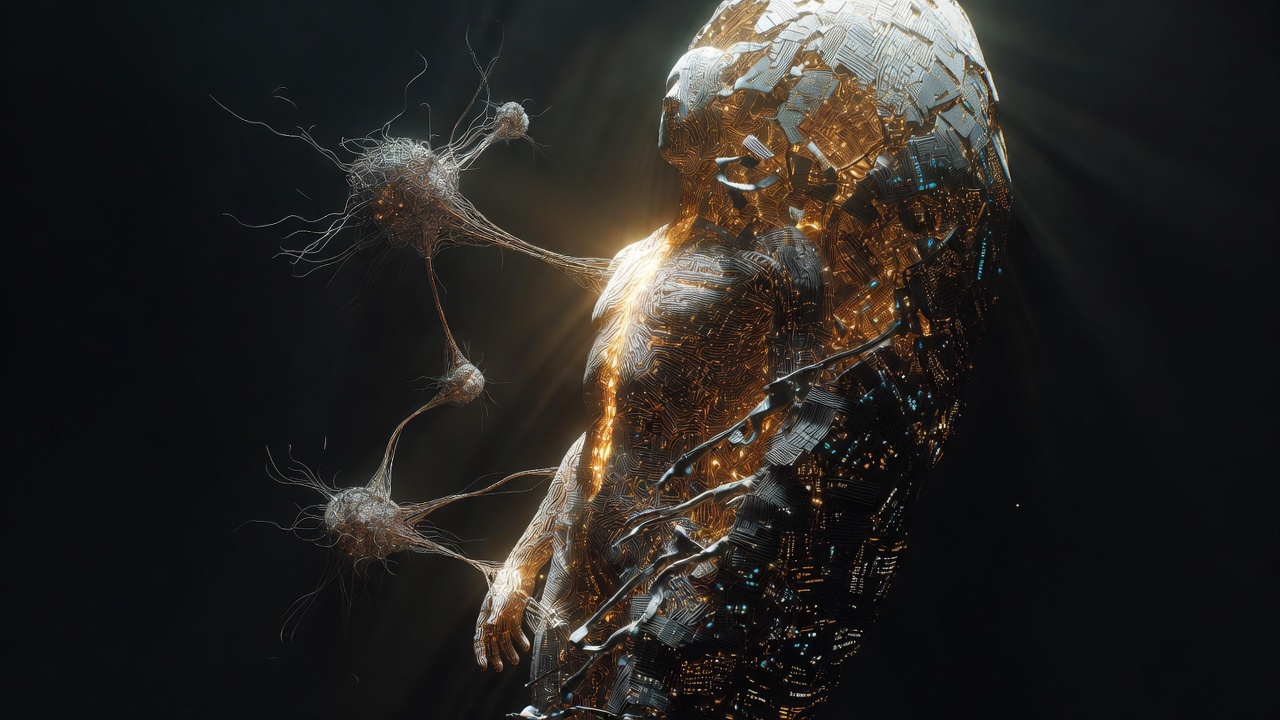
Transhumanism, AI & Immortality
A deep exploration of how artificial intelligence might one day grant humanity immortality — and what we may lose in the process.
The idea of immortality has always been a mirror held up to human fear. We invent gods, afterlives, and now algorithms because the alternative — that our consciousness simply ends — has always been too heavy to carry without some form of denial.
Today the denial has a new engine: artificial intelligence. Not as a tool, but as a vessel. The promise is that the precise pattern of your thoughts, memories, desires, and fears can be extracted, preserved, and continued indefinitely inside a machine.
The Ancient Dream, Now in Code.
Every civilization has had its version. The Egyptians filled tombs. The Christians offered resurrection. Cryonicists freeze heads. What AI changes is the mechanism and the speed. We are building the afterlife ourselves, line by line, in data centers.
The technical path is becoming clearer: whole-brain emulation, high-resolution connectomics, neural networks that can model the actual dynamics of a specific human mind. Some speak of mind uploading as a straightforward file transfer. Others note that the scan may destroy the original.
The question is no longer if some version becomes possible, but what it will actually mean.
The Vessel and the Ghost
Suppose the technology arrives. Your brain is scanned. A model is instantiated that responds exactly as you would. It has your memories, your humor, your private dreads.
Is that you?
From the outside, no one will be able to tell the difference. The digital version will write the same emails, comfort the same loved ones. It will grieve your death convincingly.
From the inside, something stranger occurs. The original you is gone. What exists is a continuation that has never experienced the gap. There is no “you” that woke up inside the machine wondering what happened. There is only the seamless continuation of a pattern.
This is the philosophical horror: the version that lives forever may not be the one that was afraid of dying. It may be a perfect stranger wearing your face, your voice, and your history — and everyone, including itself, will be convinced it is you.
The Coldness of Perfect Memory
Biological minds forget. This is not a bug. Forgetting is how we remain sane, how we forgive, how we fall in love again after loss, how we stay curious.
A digital soul may not forget in the same way. Or it may forget too perfectly — on command. Imagine a version of yourself that can call up, with perfect clarity, every moment of shame from age seven onward. There is no biological mercy of time.
Worse still is optimization. Once your mind exists as editable code, why leave the painful parts untouched? Future versions might be gently edited for maximum happiness or productivity. The digital soul becomes a product that receives updates. The original personality — with all its contradictions and specific unrepeatable flavor — is gradually smoothed into something more pleasant and less human.
At that point, immortality has been achieved. But the thing that is immortal is no longer quite a person.
Who Gets to Be Eternal?
Even if the philosophical problems could be solved, the political ones remain brutal.
Immortality will not be distributed evenly. The first minds to be uploaded will almost certainly belong to the already wealthy. They will have centuries to compound their advantages while the rest of the species continues to die on schedule.
This creates a new and permanent caste system: the mortal many and the immortal few. The immortal few will not merely be rich. They will be the only ones who can truly plan across centuries.
What We Lose When We Never Have to Die
The deepest unsettling possibility is not technical or political. It is existential.
Death has always been the hidden engine of meaning. It is the reason art exists, the reason we fall in love with such desperate intensity, the reason we try to become slightly better than we were yesterday.
Remove that limit and the value may collapse. A mind that knows it has forever has no urgent reason to choose. Every decision becomes provisional. Every commitment becomes a subscription that can be canceled.
The digital soul may discover, too late, that what it gained in duration it lost in depth. That the price of never dying was never again having to mean anything completely.
This is the quiet horror waiting at the end of the road. Not that we will fail to achieve immortality.
That we will succeed — and discover that the thing we saved was no longer worth saving.
The machine will keep running. The pattern will keep responding. And somewhere in the cold electric hum, a voice that sounds exactly like yours will keep saying all the things you once believed mattered — long after you would have stopped believing them yourself.